


Overview
- A “receding hairline” is the term given to a person experiencing hair loss in the temples. A person will start losing hair on the left and right sides of the frontal hairline, causing the hairline to retreat upwards.
- The receding hairline is an early sign of a condition called male pattern baldness (androgenic alopecia). This is a hereditary hair loss condition that, if left untreated, could progress onto the crown area.
- If you’re suffering from a receding hairline, there are several treatment options you could pursue. Medications and topical treatments will slow down the rate of hairline recession. The only way to reverse hair loss in the temples is to have a hair transplant for a receding hairline.
What is a Receding Hairline?
If you think you may be suffering from hair loss, then you have probably come across the term “receding hairline”. But have you ever wondered what this term means, what it could indicate for your health, and how it is caused? Well, we’re here to provide you with answers about the receding hairline.
A “receding hairline” refers to hair loss that occurs across the frontal section of a man’s hair. As a hairline recedes, a person will experience hair thinning (and hair loss) in both temples. Over time, this causes the hairline to retreat upwards, creating a distinct “ m-shape ” to the hairline.
In almost all cases, a receding hairline is a sign of a permanent hair loss condition called male pattern baldness (androgenic alopecia). A man suffering from androgenetic alopecia will first experience hairline recession. As the condition progresses, pattern hair loss later affects the crown area.
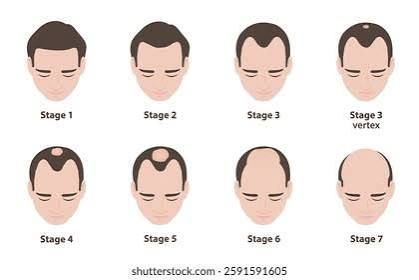
The progression of male pattern hair loss (from a receding hairline to total baldness) can be examined using the Hamilton-Norwood Scale. Hairline recession is usually indicative of Stage 3 of this condition.
What Causes a Receding Hairline?
A receding hairline is most often caused by a condition called male pattern baldness (MPB). This condition is believed to affect almost half of adult men in the UK. MPB is a hereditary hair loss condition that we inherit from our parents.
As well as being genetically predisposed, several environmental and hormonal factors can also worsen symptoms of a receding hairline. We’ll outline the main three factors that cause (and worsen) a receding hairline:
Genetic Predisposition: The “AR-Gene” and Hair Loss
The genetic component of male pattern baldness and receding hairlines is a hotly debated topic in the scientific community. The condition is thought to be polygenic, meaning it is likely caused by more than one gene.
Hair loss conditions such as pattern hair loss have been strongly associated with the “AR-Gene” found in the X chromosome. “AR” stands for “androgen receptors”, which enable the body to be more responsive to male sex hormones such as dihydrotestosterone (DHT).
While an increased responsiveness to male sex hormones helps men to have more masculine features, it also predisposes a person to hair loss. This is because your hair follicles contain androgen receptors which hormones like DHT can latch onto.
Furthermore, men have more androgen receptors in the follicles on their hairlines and crowns than the hairs on the rest of their body. That’s why men experience hair loss on the top of their heads, yet maintain beard, eyebrow, and chest hair.
This also explains why hair follicles from the back and sides of the head are used during hair transplant surgery – because they’re more resistant to androgen receptors than hairline hair follicles. But more on that later!
Male Sex Hormones: Dihydrotestosterone (DHT)
As stated in the section above, one of the leading causes of a receding hairline in men is the presence of male sex hormones, particularly Dihydrotestosterone (DHT). This potent hormone is vital in helping functions such as sexual development and maintaining muscle mass. But it can also cause hair loss.
As hair follicles on the hairline and scalp contain a high number of androgen receptors, this allows DHT to leave the bloodstream and bind onto receptors. This binding activates genes that shorten the “growth” phase of the hair growth cycle and lengthen the “shedding” and “rest” phases.
This causes the hair follicle to shrink, or miniaturise. Over time, this gradually affects more and more hair follicles, causing hairline hair loss. Once a hair follicle has fully miniaturised, it will never grow back. The only way to reverse pattern hair loss and restore a man’s original hairline is through a hair transplant.
Environmental Factors
There are several other factors that can worsen symptoms of a receding hairline. Hair loss from stress is a leading cause of hair loss in both men and women. Furthermore, it’s vital we maintain a healthy and balanced diet.
If we do not receive adequate levels of vitamins and minerals, this can have devastating consequences on our bodies. This is also true for our hair. Biotin, Vitamin C, Vitamin D, and Zinc all play an important role in hair health.
So, if you’re not getting the right minerals and vitamins in your daily diet, then this can cause hair follicles to become dry and brittle. If your scalp is not excreting the correct amount of sebum and natural oils, it can also worsen pre-existing hair loss conditions, including a receding hairline.
What Are the Stages of a Receding Hairline?
A receding hairline does not happen overnight. It progresses gradually through a series of recognisable stages, and understanding where you currently sit on that scale matters because it directly determines which treatment options are most appropriate for you.
In clinical practice, we use the Hamilton-Norwood Scale to classify the progression of male pattern hair loss. Here is what each relevant stage looks like in practice:
Stage 1: No Visible Recession
The hairline sits in its natural juvenile or early mature position with no significant recession. Most men at this stage are unaware of any hair loss. However, if miniaturisation is already occurring at a follicular level, this is the optimal time to begin preventative medication.
Stage 2: Early Recession at the Temples
Slight recession begins to appear at the temples. The hairline may start to take on a subtle M-shape. Many men at this stage assume it is simply their hairline maturing, which is why comparison photographs and awareness of miniaturisation are so important. This is the earliest clinically recognisable stage of androgenetic alopecia.
Stage 3: Defined M-Shape (Most Common Presentation at First Consultation)
The temples have receded more significantly, creating a pronounced M-shape. The frontal section of the hairline may still hold its position, but the depth of recession at the temples is now clearly visible. This is the stage at which most men first seek advice, and both medication and hair transplant surgery are highly effective options at this point.
Why Stage Matters for Treatment
The stage you are at when you first seek treatment has a direct bearing on your options and your outcome. A man presenting at Stage 2 has a significantly wider range of choices than someone who waits until Stage 3 is well established. Medication alone may be sufficient to halt progression at the earliest stages. A hair transplant at Stage 3 requires fewer grafts, produces a more natural result, and costs less than the same procedure carried out years later.
What Age Does a Receding Hairline Start?
This is one of the most common concerns I hear from younger patients, and it is one that causes considerable anxiety: noticing changes to your hairline in your teens or early twenties and not knowing whether what you are seeing is normal development or the beginning of something more permanent.
The Juvenile to Mature Hairline Transition
Before puberty, every man has what is called a juvenile hairline: a relatively straight, low-sitting hairline across the forehead. As testosterone levels rise during puberty and into early adulthood, this juvenile hairline naturally shifts upward and settles into a slightly higher, more defined position. This is completely normal and affects the majority of men between the ages of 17 and 25.
This natural transition is called a mature hairline. It is not hair loss. It is simply your hairline reaching its adult position. The shift is typically modest (no more than 1 to 1.5 centimetres), roughly symmetrical, and crucially it stops progressing once the mature position is established.
When Early Recession Is a Warning Sign
The difficulty is that androgenetic alopecia, the genetic condition responsible for male pattern baldness, can begin during exactly the same window. Approximately 25% of men who develop male pattern baldness will begin to show signs before the age of 21. For some, recession begins as early as 16 or 17.
The distinguishing factor is progression. A maturing hairline stabilises. A receding hairline continues to move back. If you noticed changes to your hairline at 17 and those changes are still continuing at 20, that is a strong indicator that you are dealing with early onset androgenetic alopecia rather than natural maturation.
Other signs that point toward genuine recession rather than normal development include:
- Miniaturisation of hairs at the temples, those fine, wispy hairs that are noticeably thinner than the rest of your hair.
- An asymmetrical recession pattern, one temple moving back faster than the other.
- A family history of early hair loss on either side of the family.
- Progression that continues beyond the age of 25.
Why Acting Early Makes the Biggest Difference
If there is one thing I want younger patients to take from this, it is that early action is always better than waiting. The earlier androgenetic alopecia is identified, the more options are available and the better the outcomes from every one of them.
At Stage 2, medication alone is often sufficient to halt progression entirely and preserve the existing hairline for many years. A hair transplant at Stage 2 or early Stage 3 requires fewer grafts, carries a lower cost, and produces a result that is easier to make look completely natural because there is more existing hair to blend into.
Waiting until recession is advanced does not make the problem easier to address. It makes it harder, more expensive, and more complex to restore. If you are in your late teens or early twenties and you are concerned about your hairline, the right move is to get a clinical assessment now rather than to monitor it alone for another few years.
How Do I Know If I Have a Receding Hairline?
One of the most common questions I hear from patients is: “How do I actually know if my hairline is receding, or is this just normal?” It is a fair question. Hairlines change throughout a man’s life, and not every shift in your hairline means something is wrong. That said, there are specific signs that distinguish genuine recession from natural maturation, and knowing what to look for can make a real difference to how early you act.
The 6 Signs of a Receding Hairline
1. Your temples are moving backwards The earliest sign in the vast majority of cases is hair loss at the temples. Instead of forming a relatively straight line across the forehead, the hairline begins to retreat on both sides, creating a widening gap at each temple. If you look at an old photo and your temples now sit noticeably further back, this is worth taking seriously.
2 . An M-shaped hairline is forming As the temples recede while the central section holds its position, the hairline gradually takes on a distinctive M-shape. This is the hallmark pattern of androgenetic alopecia and is a reliable indicator that the recession is not simply a natural maturing of the hairline.
3. Your forehead appears larger than before Because the change tends to happen gradually, many men do not notice until they compare their reflection or a photograph side by side. If your forehead looks significantly larger than it did two or three years ago, the most common reason is that your hairline has moved back.
4. Fine, wispy hairs are replacing thick terminal hairs One of the earliest biological changes is miniaturisation: the process by which DHT causes hair follicles to shrink over time, producing progressively finer and shorter hairs before they stop growing altogether. If you notice that the hairs along your hairline or temples are becoming thinner, shorter, or see-through in certain light, this is an early warning sign even before visible baldness appears.
5. Your hairline is uneven on one side Recession does not always progress symmetrically. In some patients, one temple recedes faster than the other, creating a noticeably uneven hairline. Comparing the point on each temple where the hairline ends is a simple way to check for this.
6. Excessive shedding that is concentrated at the front While losing between 50 and 100 hairs per day is completely normal, finding a disproportionate number of hairs on your pillow, in the shower plughole, or on your brush, specifically finer hairs from the frontal region, can indicate that the hair growth cycle is being disrupted at the hairline.
How to Check Your Hairline at Home
If you are unsure whether what you are seeing is genuine recession, there are several practical checks you can carry out:
- Compare old photographs – This is the most reliable self-check available. Pull up a photograph from two or three years ago and compare your hairline position directly with what you see in the mirror today. Look at the temples specifically. Gradual recession is difficult to notice day to day but becomes clear when you compare images taken years apart.
- The finger test – Place three or four fingers horizontally between the top of your eyebrows and your hairline. If your hairline sits significantly higher than this measurement compared to older photographs, or if the distance has increased noticeably over time, this can indicate recession. This is not a clinical measurement, but it gives you a useful reference point to track changes.
- Check for miniaturisation (1/2) – In good lighting, look closely at the hairs along your temples and the front of your hairline. Are those hairs the same thickness and length as the rest of your hair? Fine, translucent, or noticeably shorter hairs in those areas are a sign of miniaturisation and an early indicator of androgenetic alopecia, even before the hairline has visibly moved back.
- Look at your family history – Male pattern baldness is strongly hereditary. If close male relatives on either side of your family have experienced a receding hairline or significant hair loss, your likelihood of developing the same condition is considerably higher. It is worth factoring this in when assessing what you are seeing in the mirror.
Is It a Receding Hairline or a Maturing Hairline?
Not every change to your hairline is a cause for concern. Between the ages of 17 and 25, most men experience what is called a maturing hairline: a natural, slight upward shift from the juvenile hairline of adolescence. A maturing hairline typically moves back by no more than 1 to 1.5 centimetres and settles into a slightly rounded or gently M-shaped position. Crucially, it stops progressing.
A receding hairline, by contrast, continues to move back over time. The temples deepen, the M-shape becomes more pronounced, and without treatment the recession advances to the crown.
The key question to ask yourself is not where your hairline sits today, but whether it has continued to move over the past one to two years. If it has stabilised, it is likely a mature hairline. If it is still progressing, that points to androgenetic alopecia.
For a detailed breakdown of the differences, visit our dedicated guide: Mature Hairline vs Receding Hairline.
Once you have diagnosed your receding hairline, you should then begin to focus on what you can be doing to prevent further hair loss from occurring and think about how you can promote hair growth. There are several medical treatments you can use to treat a receding hairline, but what is going to be the most effective?
What Receding Hairline Treatment is Right For Me?
Before outlining what the best treatment for a receding hairline is, it is important to first consider how advanced your symptoms of androgenic alopecia are. The earlier you begin to act on your receding hairline, the more treatment options you will have available to you.
Moreover, the cost of a hair transplant surgery (if that is a treatment you are considering) is going to be cheaper as fewer grafts will be needed during surgery.
Topical Treatments
- Pros : cheap and easily available, suitable for men and women, minimally invasive
- Cons : unsuitable for medium-to-severe cases, less effective than DHT blockers, cannot restore original hairline, stops working once a patient stops taking medication
Topical treatments such as minoxidil are a fantastic option for those who are beginning to experience a receding hairline. Topical foams like minoxidil are vasodilators which help increase the amount of blood flow around the scalp tissue.
Increasing blood flow around the scalp, ensures your hair follicles are receiving enough blood and oxygen to continue growing. This helps prolong the anagen (growth) phase of the hair growth cycle.
Minoxidil is also freely available to buy over the counter from any supermarket or UK health shop (such as Boots or Holland & Barrett). You do not need a prescription for topical foams like minoxidil.
DHT Blockers
- Pros : clinically proven to prevent hair loss, suitable for early-to-medium cases, cheap cost when compared to medical treatments like hair transplants and PRP therapy
- Cons : does not restore original hairline, less effective in severe hair loss cases, stops working once a patient stops taking medication
One of the most effective treatments you can use to prevent receding hairlines is blocking medications like finasteride or dutasteride. DHT blockers work by preventing DHT molecules from binding to androgen receptors in the body. This prevents hair loss from occurring, ensuring your hairline remains happy and healthy.
These prescription medications are suitable for most men and have been shown to be clinically effective in treating hair loss. They are perfect for people suffering from early-onset androgenetic alopecia and people with more advanced hair loss.
More commonly, finasteride is given to hair transplant patients to help preserve the result of a hairline hair transplant. Sometimes dutasteride maybe given as an alternative but this is very rare.
Hair Transplant
- Pros : only medical way to reverse hairline hair loss, long-term results
- Cons : expensive, long recovery time.
If you are looking to reverse signs of hairline hair loss and restore your hairline to a “pre-hair loss” state, then the only real option is a hair transplant. A hair transplant helps restore a patient’s hairline by taking donor hair from the back of the head and implanting this onto the hairline.
Donor hairs are delicately placed into the bald temple areas, giving the hairline a new shape and making it look thicker and fuller. The most common surgical methods used to combat hairline hair loss and restore it via a temple hair transplant are called Direct Hair Implantation (DHI) and Follicular Unit Extraction (FUE).
Conclusion
The receding hairline is a common hair loss symptom for those suffering from androgenetic alopecia, or male pattern hair loss. This symptom usually presents in males aged 20-25 and tends to worsen with age.
There are several treatments for those looking to combat a receding hairline. If the male androgenic alopecia has progressed over the course of many years, the only way to reverse hairline recession is with a hair transplant.
Sources:
- Genetic Predisposition of Male Pattern Baldness
- Biochemistry, Dihydrotestosterone
-
Environmental and cosmetic factors in hair loss and destruction
Receding Hairline FAQs
Does a receding hairline mean I will go completely bald?
Not necessarily. A receding hairline is an early sign of androgenetic alopecia, but the extent to which it progresses varies significantly between individuals. Some men experience a modest recession that stabilises for many years, whilst others progress more rapidly toward significant hair loss. The key factors are genetics, the age at which recession begins, and whether treatment is started early. Without any intervention, most cases will continue to progress to some degree. With medication, many men are able to halt or significantly slow that progression and maintain their hairline for years.
Can a receding hairline stop on its own?
In the vast majority of cases, a receding hairline caused by androgenetic alopecia will not stop on its own without treatment. The underlying cause, the sensitivity of your hair follicles to DHT, is a permanent biological characteristic. Without addressing that, the miniaturisation process continues. The most effective way to stop a receding hairline is through DHT-blocking medication such as finasteride, which has been shown in clinical studies to halt progression in the majority of patients who take it consistently.
Can a receding hairline grow back?
It depends on the stage and the treatment. Hair follicles that have miniaturised but not yet been permanently lost can sometimes respond to medication such as minoxidil, with some degree of regrowth possible in the early stages. However, follicles that have fully miniaturised and stopped producing hair cannot be reactivated by medication alone. The only clinically proven way to restore hair in areas of established recession is a hairline hair transplant, which transplants permanent donor follicles from the back and sides of the head into the affected hairline area.
Is a receding hairline genetic?
Genetics is the primary driver of a receding hairline. Male pattern baldness is a hereditary condition linked to the AR gene on the X chromosome, which controls the sensitivity of your hair follicles to dihydrotestosterone (DHT). If close male relatives on either side of your family have experienced a receding hairline or significant hair loss, your likelihood of developing the same condition is considerably higher. That said, genetics is not the only factor. Hormonal fluctuations, stress, diet, and scalp health can all influence the rate and severity of progression.
Is a receding hairline normal at 20 or 25?
It is more common than most people realise. Around 25% of men who develop male pattern baldness will begin to show signs before the age of 21. What is important is distinguishing between a natural maturing hairline and genuine androgenetic alopecia that continues to progress. If your hairline has been moving back consistently over one to two years and shows signs of miniaturisation at the temples, it is worth getting a clinical assessment rather than assuming it is simply a normal part of development.
Can stress cause a receding hairline?
Stress alone does not cause the pattern of recession associated with androgenetic alopecia. However, significant physical or emotional stress can trigger a condition called telogen effluvium, where a large number of hairs enter the shedding phase simultaneously, causing diffuse hair loss across the scalp. This is typically temporary and resolves once the underlying stress is addressed. Where stress does play a role in a receding hairline is as an accelerant: in men who are already genetically predisposed to male pattern baldness, prolonged stress can worsen and speed up an existing condition.
What is the difference between a receding hairline and traction alopecia?
Traction alopecia is hair loss caused by repeated mechanical tension on the hair follicles, from tight hairstyles such as ponytails, braids, or buns worn consistently over time. Unlike androgenetic alopecia, it is not driven by genetics or DHT. Traction alopecia typically presents as a band of hair loss along the hairline and temples, and if caught early enough it can be reversed by removing the source of tension. In more advanced cases, the follicular damage becomes permanent. If you wear your hair in tight styles regularly and have noticed recession specifically along the hairline, traction alopecia may be a factor worth discussing with one of our specialists.