The role of genetics in baldness explained
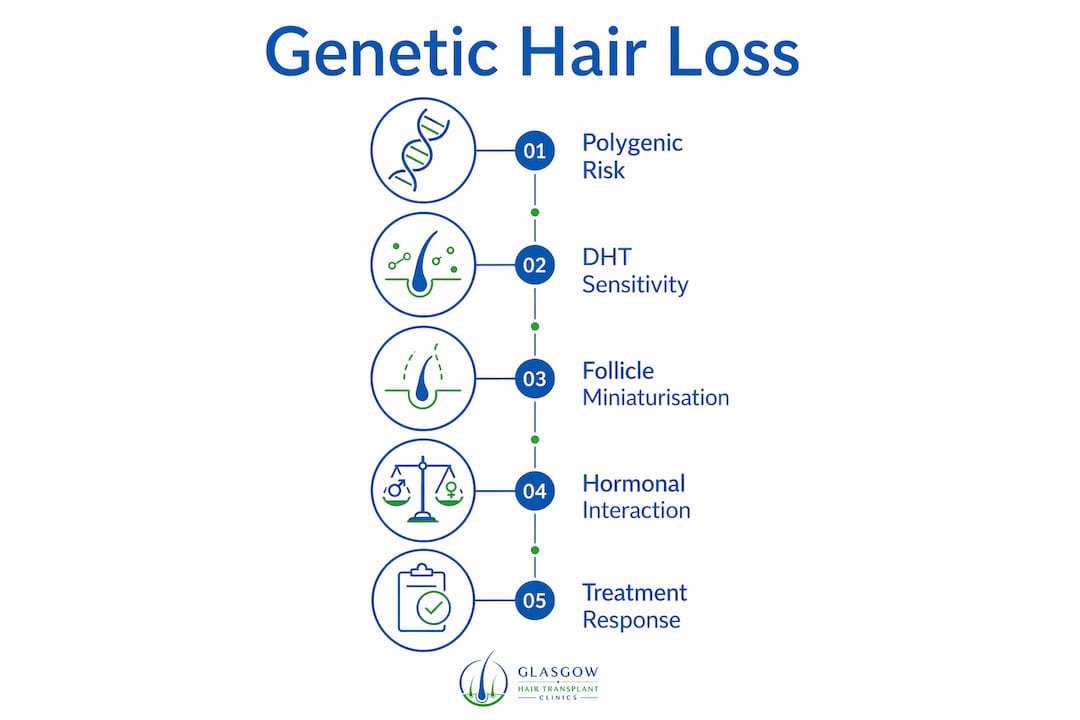
Androgenetic alopecia, the clinical term for hereditary baldness, is defined as a polygenic condition in which multiple inherited genes determine how sensitive your hair follicles are to hormones. The role of genetics in baldness is not a single gene flipping a switch. Over 200 genetic variants
inherited from both parents combine to set your individual risk. Twin and family studies show up to 80% heritability for androgenetic alopecia, making it one of the most genetically influenced common conditions in medicine. Nearly 70% of Caucasian men will experience some degree of hair loss by age 70. Understanding why this happens is the first step towards doing something about it.
What genes are involved in hereditary baldness?
Androgenetic alopecia is polygenic. No single “baldness gene” exists, and consumer genetic testing kits often capture only a limited portion of the total risk, giving them low predictive power
in practice. The genetic architecture is spread across many chromosomes, with variants affecting multiple biological pathways.
The most studied gene is the androgen receptor (AR) gene, located on the X chromosome. Because men inherit their X chromosome from their mother, this is where the old “look at your maternal grandfather” myth originates. The AR gene influences how strongly your follicles respond to androgens. A more sensitive receptor means follicles react more aggressively to circulating hormones.
Beyond the AR gene, the picture becomes considerably more complex:
- Autosomal variants:
Over 200 loci
spread across non-sex chromosomes contribute to baldness risk, inherited from both parents equally.
- WNT signalling pathway:
Variants in WNT pathway genes affect follicle development and regeneration cycles, influencing how well follicles recover between growth phases.
- Androgen metabolism genes:
Genes encoding enzymes like 5-alpha reductase (which converts testosterone to dihydrotestosterone, or DHT) also vary between individuals, affecting how much DHT reaches follicle tissue.
- Follicle development genes:
Variants affecting the structural development of the follicle itself determine baseline follicle resilience.
- Population-specific architecture:
Polygenic risk scores show different genetic architectures across ethnicities, meaning predictive accuracy varies significantly by ancestry.
Pro Tip:
If you are considering a consumer DNA test for baldness risk, treat the result as indicative rather than definitive. The test captures a fraction of the variants involved and cannot account for the full polygenic picture.
How do genetics and hormones interact to cause hair loss?
DHT is the direct hormonal trigger for male pattern hair loss. DHT interacts with androgen-sensitive follicles
that are genetically predisposed to react to it, causing a process called follicle miniaturisation. Genetics determine which follicles carry sensitive androgen receptors. Hormones then act on those specific follicles.
The miniaturisation process works as follows:
- DHT binds to androgen receptors
in the dermal papilla cells at the base of genetically susceptible follicles.
- The growth phase shortens.
Each successive hair growth cycle (anagen phase) becomes progressively shorter, producing thinner, shorter hairs.
- The follicle shrinks.
Over months and years, the follicle itself reduces in diameter, producing vellus (fine, colourless) hairs instead of terminal (thick, pigmented) hairs.
- The resting phase lengthens.
The follicle spends more time dormant (telogen phase) and less time actively growing.
- Visible thinning appears.
By the time you notice thinning, follicles have typically been miniaturising for months or years already.
A critical point: follicles on the back and sides of the scalp carry different genetic programming. They are not sensitive to DHT, which is precisely why hair loss follows predictable patterns and why donor hair from these areas remains viable for transplantation. This is also why male pattern hair loss is an internal hormonal and genetic process, not caused by hat wearing, poor shampoo choice, or scalp circulation. Those factors do not alter your follicles’ genetic sensitivity to DHT.
For younger men noticing early signs of thinning, understanding this mechanism matters. The hair loss solutions for young men
available today are most effective when started before miniaturisation is advanced.
Does baldness come from your mother’s or father’s side?
The short answer is both. The longer answer explains why the maternal grandfather myth persists and why it is only partially correct.
The AR gene sits on the X chromosome. Men inherit their single X chromosome from their mother, who inherited it from either her mother or her father. This means your maternal grandfather’s hairline does carry some predictive weight, specifically for AR gene variants. That is the grain of truth behind the myth.
The full picture is considerably broader:
- Both parents contribute autosomal genes.
Dozens of autosomal loci influencing baldness risk are inherited from both your mother and your father in equal measure.
- Your father’s hairline is directly relevant.
Paternal autosomal variants contribute meaningfully to your overall polygenic risk score.
- Siblings can have very different outcomes.
Because polygenic inheritance involves random assortment of many variants, two brothers can inherit quite different combinations from the same parents.
- Female pattern hair loss follows partly distinct pathways.
Emerging research shows immune system activation
plays a role in female pattern hair loss, suggesting the genetic and biological mechanisms are not identical to the male pattern.
- Ethnic background matters.
Genetic risk variants and their frequencies differ across populations, so family history within your own ancestry is the most relevant predictor.
The practical implication is straightforward. If either parent, or any grandparent on either side, experienced significant hair loss, your genetic risk is elevated. A thorough hair loss consultation
that takes your full family history into account gives a far more accurate picture than any single gene test.
How does genetic knowledge affect treatment and prediction?
Understanding your genetic predisposition changes how you approach treatment in two concrete ways: it informs timing, and it shapes which treatments are likely to work for you.
Timing and early intervention
Miniaturisation is gradual and largely invisible in its early stages. By the time thinning is clearly visible, a proportion of follicles may already be dormant. Early intervention preserves more follicles and produces better long-term outcomes. Genetics tells you whether you are at elevated risk before significant loss occurs, which is the strongest argument for acting on early warning signs rather than waiting.
Treatment responsiveness and pharmacogenetics
Genetic variations influence how individuals respond
to treatments such as minoxidil and finasteride, affecting both efficacy and side-effect profiles. This field, pharmacogenetics, is still developing, but it already explains why two patients with similar hair loss patterns can have very different responses to the same treatment. Precision medicine approaches that account for individual genetic profiles are emerging as the next step in personalised hair loss care.
The table below summarises the current state of genetic knowledge as it applies to treatment decisions:
| Approach |
What genetics tells you |
Current limitation |
| Pharmacogenetics |
Likely response to minoxidil or finasteride |
Tests not yet standard in clinical practice |
| Polygenic risk scores |
Overall susceptibility level |
Accuracy varies by ethnic background |
| Family history assessment |
Practical risk indicator across both parents |
Does not predict exact pattern or timing |
| Follicular Unit Extraction (FUE) |
Donor follicles are genetically DHT-resistant |
Requires stable donor area; timing matters |
Pro Tip:
Genetic tests available directly to consumers are not the same as clinical pharmacogenetic assessments. If you want genetics-informed treatment planning, ask a qualified clinician rather than relying on a postal kit.
The most reliable path remains a professional clinical assessment that combines family history, current hair loss pattern, scalp examination, and, where appropriate, emerging genetic tools. Glasgowhairtransplantclinics offers exactly this kind of structured evaluation, with GMC-registered surgeons who understand the full genetic and hormonal picture.
Key takeaways
Hereditary baldness is a polygenic condition driven by over 200 genetic variants inherited from both parents, interacting with DHT to cause progressive follicle miniaturisation.
| Point |
Details |
| Genetics is the primary driver |
Up to 80% of androgenetic alopecia risk is genetic, confirmed by twin and family studies. |
| Both parents contribute |
Over 200 autosomal and X-linked variants are inherited from both sides of the family. |
| DHT acts on genetically sensitive follicles |
Only follicles with inherited androgen receptor sensitivity miniaturise in response to DHT. |
| Early intervention is more effective |
Miniaturisation is gradual; visible thinning means follicles have been affected for months or years. |
| Genetic tests have real limits |
Consumer kits capture a fraction of risk variants and have low predictive accuracy, especially across ethnicities. |
Why genetic awareness changes everything about how I approach hair loss consultations
The single biggest misconception I encounter is the belief that hair loss is inevitable and therefore not worth addressing early. Genetics does establish your predisposition, but predisposition is not destiny in terms of timing or severity.
What I have found consistently is that patients who understand the polygenic nature of their risk make better decisions. They do not waste time on unproven topical products. They do not wait until the Norwood scale has advanced significantly before seeking a proper assessment. They ask the right questions about their family history on both sides, not just their maternal grandfather.
The other thing worth stating plainly: the science is moving quickly. Pharmacogenetics is beginning to give clinicians real tools to match treatments to individual genetic profiles. The new generation of treatments
entering clinical use are being developed with genetic responsiveness in mind. That is a genuine shift from the one-size-fits-all approach that dominated for decades.
My honest view is that the most valuable thing you can do right now is get a proper clinical assessment that documents your current hair loss stage, your family history, and your treatment options. That baseline is worth far more than any consumer genetic test. It gives you something to act on.
Personalised hair loss assessment at Glasgowhairtransplantclinics
Knowing that genetics drives your hair loss is useful. Knowing exactly where you are in that process, and what your options are, is what actually changes outcomes.
Glasgowhairtransplantclinics provides thorough clinical assessments that combine your family history, current hair loss pattern, and scalp evaluation to build a treatment plan grounded in evidence. Our GMC-registered surgeons and CQC-registered clinics offer procedures including Follicular Unit Extraction (FUE), Platelet Rich Plasma (PRP) therapy, and Scalp Micro Pigmentation (SMP), all at transparent prices across Glasgow, Newcastle, and other UK locations. A free consultation, online or face to face, is the right starting point. Book your assessment
today, or review hair transplant costs and options
to understand what is available to you.
FAQ
Does baldness come from the mother’s or father’s side?
Baldness is inherited from both sides. The androgen receptor (AR) gene on the X chromosome comes from the mother, but over 200 autosomal variants contributing to baldness risk are inherited from both parents.
Can a genetic test predict whether I will go bald?
Current consumer genetic tests have low predictive power for baldness because they capture only a fraction of the relevant variants. Accuracy also varies significantly by ethnic background.
What is the role of DHT in genetic hair loss?
DHT binds to androgen receptors in follicles that are genetically sensitive, triggering miniaturisation. Follicles without this genetic sensitivity to DHT are unaffected, which is why hair loss follows predictable patterns.
Does wearing hats or washing hair frequently cause baldness?
No. Male pattern hair loss is an internal hormonal and genetic process. External factors such as hat wearing or shampoo frequency do not alter follicle sensitivity to DHT.
When is the best time to start treating genetic hair loss?
The earlier the better. Miniaturisation is gradual, and visible thinning typically means follicles have been affected for months or years. Early treatment preserves more follicles and produces better long-term results.
Recommended
Why pattern hair loss runs in families
Androgenetic alopecia is the medical name for male and female pattern hair loss. Inheritance is complex: a relative's hairline can be a useful clue, but it cannot tell you exactly when thinning will begin or how far it will progress. It is too simple to blame one parent or one grandparent. MedlinePlus Genetics describes the inherited and hormonal factors involved.
One area of research involves the androgen receptor gene, which helps cells respond to hormones such as dihydrotestosterone (DHT). In susceptible scalp follicles, androgen activity can shorten the growth phase and produce progressively finer hair. The biology of female pattern loss is less fully understood, and many affected women do not have raised androgen levels.
What family history can tell your clinician
Before an assessment, note which relatives on either side of the family have thinning, roughly when it became noticeable and whether their loss was gradual or patchy. Old photographs can help if the dates are known. There is no need to obtain relatives' private medical records.
A family history is one part of the consultation. The clinician also needs to examine your own scalp, look at the distribution of thinning and ask about changes over time. A strong family history should not be used to dismiss sudden shedding, scalp inflammation or a new patch of hair loss.
Genetic risk is not a diagnosis
A consumer DNA result should not be treated as a timetable for future baldness or a prescription for treatment. Before paying for a test, ask what decision it would change, whether it has been validated for people with your background and how its limitations will be explained. A risk estimate cannot replace examination of the hair you have now.
There is also a difference between genetic research and an established clinical service. This guide does not advertise a genetic test or claim that DNA analysis can reliably select the best medicine for an individual patient.
Other causes can occur alongside inherited thinning
A person with pattern hair loss can also develop temporary shedding after illness, major stress, childbirth or significant weight loss. Tight hairstyles, scalp disease and some medicines can cause different forms of loss. Seek medical advice if the change is sudden, patchy, painful or accompanied by redness or scaling. The NHS hair-loss overview
explains why identifying the cause matters before buying treatment.
How this affects treatment planning
Treatment decisions depend on the diagnosis, current pattern, your health and your preferences. For male pattern loss, topical minoxidil or prescription finasteride may be considered after advice on suitability, side effects and the need for ongoing treatment to maintain benefit. Neither is guaranteed to work. See the Danish patient guide to male pattern hair loss
and discuss the current Danish product information with your prescriber.
You can also choose to monitor your hair or use cosmetic options. Understanding inherited risk is a reason to plan thoughtfully; it is not a reason to rush into medication or surgery.
Why donor assessment still matters
A transplant redistributes existing follicles. It does not change the genetic tendency of surrounding natural hair to thin. The donor area must be examined for density, miniaturisation and the amount of hair that can reasonably be used over a lifetime. Hair at the back and sides should not simply be described as immune to every kind of hair loss.
Ask how the proposed hairline would look if thinning continues and how donor hair would be reserved for possible future needs. For Denmark enquiries, any surgical plan and price should be set out in an individual written quotation in Danish kroner. Read more about FUE
or bring these questions to a consultation.
About Dr Harpreet Kalra
Dr Harpreet Kalra
was born in Norway. His hair-restoration consultations consider the cause of hair loss, donor supply and the longer-term plan. UK GMC reference 7126076.
Understand your own pattern
Contact Denmark Hair Transplant Clinics to discuss your history and the questions you want answered before treatment.
Request a consultation