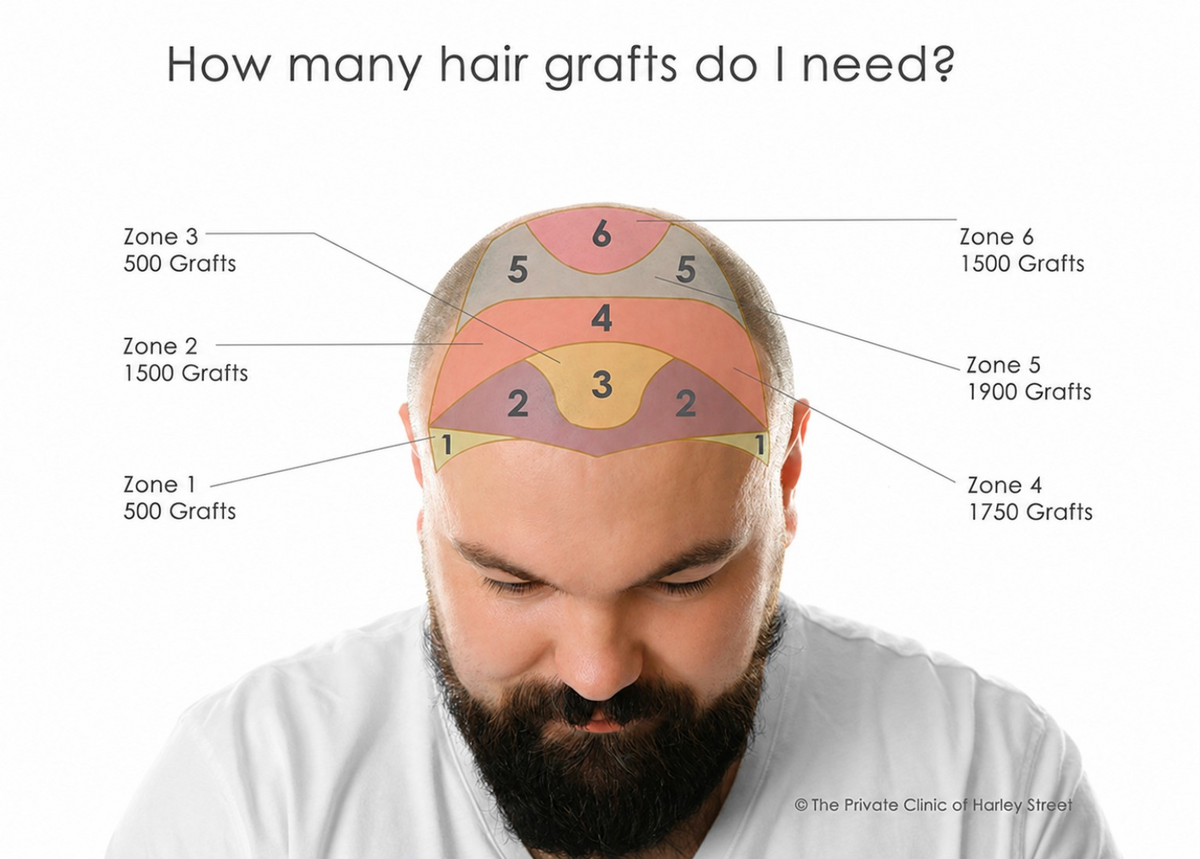
Hair loss stages checklist: your complete UK guide
A hair loss stages checklist is a structured system for identifying where you are on a recognised clinical scale, so you can make informed decisions about treatment before the window for effective intervention closes. The two industry standards are the Norwood Scale for men and the Ludwig Scale for women. Androgenetic alopecia affects over 85% of men by age 70
in the UK, yet most people wait years before seeking help. Understanding your stage is not just reassuring. It is the first step toward doing something about it.
1. What are the recognised stages of male pattern hair loss?
The Norwood Scale classifies male pattern baldness
into seven main stages plus a Type A variant, and it is the most widely accepted system in clinical settings worldwide. Each stage describes a distinct visual pattern, making it practical for self-assessment and professional treatment planning.
| Stage |
Key visual features |
Clinical notes |
| Stage 1 |
No visible recession |
Baseline; no treatment needed |
| Stage 2 |
Slight temple recession |
Early monitoring recommended |
| Stage 3 |
Deeper temple recession |
First stage where treatment is typically advised |
| Stage 3 Vertex |
Crown thinning begins |
Dual-zone loss starting |
| Stage 4 |
Significant crown and temple loss |
Medication most effective here |
| Stage 5 |
Bridge of hair narrows between zones |
Surgical options become relevant |
| Stage 6 |
Bridge disappears; zones merge |
Transplant candidacy assessed |
| Stage 7 |
Horseshoe pattern only |
Advanced loss; surgical planning critical |
The Type A variant follows a different pattern, with the hairline receding uniformly from front to back rather than from the temples inward. This matters clinically because Type A patients often show less crown involvement, which affects both diagnosis and the areas a surgeon would target.
Stages 1 and 2 carry the highest treatment potential. Follicles are still active and respond well to medical therapy. By Stage 5 and beyond, follicle miniaturisation
caused by DHT has typically progressed to a point where regrowth is unlikely without surgical intervention.
Pro Tip:
Take a photograph of your hairline and crown under consistent lighting every three months. Comparing images side by side is far more reliable than relying on memory alone.
2. How to identify the stages of female pattern hair loss
Female pattern hair loss uses the Ludwig Scale, which describes three grades of thinning focused on the crown rather than the hairline. This is the defining difference from male pattern loss: women retain the frontal hairline
even as the crown thins, which can make progression harder to notice in early stages.
| Ludwig grade |
Norwood equivalent |
Key features |
| Grade I |
Stages 1–2 |
Mild part widening; density loss subtle |
| Grade II |
Stages 3–4 |
Wider part; visible scalp on crown |
| Grade III |
Stages 5–7 |
Advanced crown denudation; scalp clearly visible |
Grade I is the most common presentation in women under 40. The thinning is diffuse, meaning hair sheds across the crown rather than in a defined patch. Many women attribute this to stress or diet and delay seeking assessment.
Grade III represents significant loss and often requires a combination of medical and surgical approaches. Frontal thinning in women falls outside the Ludwig Scale’s scope and may indicate a separate condition requiring additional clinical evaluation beyond standard pattern hair loss assessment.
Pro Tip:
Part your hair down the centre under bright light and photograph the width of the parting. A widening part is the earliest visible sign of Ludwig Grade I thinning.
3. How can you track your hair loss progression effectively?
Tracking hair loss progression requires a consistent method, not occasional glances in the mirror. A structured checklist helps you notice gradual changes that are easy to miss day to day.
Self-observation checklist:
- Check your hairline at the temples and forehead monthly. Note any recession compared to previous photographs.
- Examine the crown under direct overhead light. Look for increased scalp visibility or a widening parting.
- Monitor daily shedding. Collecting shed hairs on a white surface for a week gives a rough baseline count.
- Note whether shedding has increased suddenly or changed in pattern, such as appearing in clumps rather than individual strands.
- Check for scalp symptoms: itching, redness, flaking, or tenderness. These are not typical of androgenetic alopecia.
- Record any changes in hair texture, such as strands becoming finer or shorter over time.
Sudden, patchy loss or loss accompanied by scalp symptoms are red flags. UK dermatological guidelines recommend urgent GP assessment when hair loss is sudden, patchy, or associated with systemic symptoms, as these indicate non-pattern causes such as alopecia areata or telogen effluvium.
Misdiagnosing hair loss type
leads directly to treatment failure. A clinical evaluation confirms whether you are dealing with androgenetic alopecia or a condition that requires a completely different approach. Preparing thoroughly for that appointment makes a real difference. A consultation preparation guide
can help you arrive with the right information and questions ready.
4. What treatment options correspond to each hair loss stage?
Treatment effectiveness is directly tied to stage. Starting earlier preserves more follicles and produces better outcomes. Follicles that miniaturise past a certain point are unlikely to recover without surgical intervention, which is why stabilisation is the primary goal of early treatment.
Early stages (Norwood 1–3, Ludwig Grade I):
- Minoxidil (available over the counter) applied topically stimulates blood flow to follicles and slows miniaturisation.
- Finasteride (prescription only for men) blocks DHT at the follicle level. Clinical trials show finasteride halts hair loss in 83–87% of men after two years, with two thirds experiencing measurable regrowth.
- Consistent use over a minimum of six months is required before effectiveness can be assessed.
Middle stages (Norwood 3–4, Ludwig Grade II):
- Combination therapy using both minoxidil and finasteride produces stronger results than either alone.
- Platelet Rich Plasma (PRP) therapy delivers concentrated growth factors directly to the scalp, supporting follicle health. Glasgowhairtransplantclinics offers PRP treatment sessions
as a non-surgical option at this stage.
- Low-level laser therapy is an adjunct option used alongside medication to support follicle activity.
Advanced stages (Norwood 5–7, Ludwig Grade III):
- Hair transplant surgery, including Follicular Unit Extraction (FUE) and Direct Hair Implantation (DHI), becomes the most effective option.
- Crown hair transplants address the most common area of advanced loss in men.
- Scalp Micro Pigmentation (SMP) provides a non-surgical cosmetic solution for those who are not surgical candidates.
The goal at every stage is stabilisation first, then restoration where possible. Expecting regrowth from advanced follicle loss without surgery leads to disappointment. Reviewing the full range of UK treatment options
helps set realistic expectations from the outset.
Key takeaways
The most effective approach to managing hair loss is identifying your clinical stage early and matching your treatment to that stage before follicle miniaturisation becomes irreversible.
| Point |
Details |
| Use recognised clinical scales |
The Norwood Scale (men) and Ludwig Scale (women) are the standard tools for staging hair loss. |
| Start tracking early |
Monthly photographs and a self-observation checklist catch progression before it becomes obvious. |
| Match treatment to stage |
Medication works best at early stages; surgical options become necessary at advanced stages. |
| Act on red flags promptly |
Patchy loss, scalp symptoms, or sudden shedding require urgent GP assessment, not self-treatment. |
| Private assessment avoids delays |
NHS referral waits of 6–18 months risk further progression before treatment begins. |
Why a checklist changes everything about how you approach hair loss
Most people I speak with assume hair loss is inevitable and that nothing meaningful can be done until it is already obvious. That misconception is the single biggest reason people arrive at a clinic at Norwood Stage 5 when they could have come at Stage 2.
The checklist approach reframes the whole experience. Instead of reacting to hair loss after the fact, you are monitoring a measurable process with known stages and known interventions at each point. That shift from passive observation to active tracking changes outcomes in a very practical way. You notice the transition between stages sooner, you seek assessment earlier, and you start treatment while it still has the most to offer.
NHS referral waits of 6 to 18 months mean that even people who do seek help early can lose ground before treatment begins. Private assessment removes that delay entirely. The psychological benefit of having a clear plan should not be underestimated either. Knowing your stage, understanding what it means, and having a treatment pathway removes a significant amount of anxiety from the process.
The checklist is not a substitute for clinical diagnosis. It is the preparation that makes clinical diagnosis faster, more productive, and more likely to result in a treatment plan that actually fits your situation.
Glasgowhairtransplantclinics: expert assessment from stage one onwards
Glasgowhairtransplantclinics provides expert hair loss assessment and treatment across Glasgow and the wider UK, with surgeons on the GMC register and clinics registered with the CQC and HIS.
Whether you are at an early stage and want to start medication, or at an advanced stage considering a hairline hair transplant, the team offers a clear, personalised assessment from the first appointment. Private consultations are available online or face to face, with no NHS waiting list delays. Treatments include FUE and DHI hair transplants, PRP therapy, SMP, and hair loss medication
management. Book a free consultation today and find out exactly where you stand.
FAQ
What is the Norwood Scale used for?
The Norwood Scale classifies male pattern hair loss into seven stages and is the standard clinical tool for assessing progression and planning treatment, including transplant candidacy.
How does the Ludwig Scale differ from the Norwood Scale?
The Ludwig Scale describes female pattern hair loss in three grades focused on crown thinning, while the Norwood Scale maps hairline and crown recession in men across seven stages.
When should I see a doctor about hair loss?
See a GP promptly if hair loss is sudden, patchy, or accompanied by scalp symptoms such as itching or redness, as these signs indicate non-pattern causes that require clinical assessment.
Can hair loss be reversed at any stage?
Early stage hair loss responds well to minoxidil and finasteride, with finasteride halting loss in 83–87% of men in clinical trials. Advanced miniaturisation is unlikely to reverse without surgical intervention.
How often should I check my hair loss progression?
Monthly self-checks using photographs under consistent lighting, combined with a structured observation checklist, provide the most reliable way to track changes between professional appointments.
Recommended
What a stage can and cannot tell you
A hair-loss scale describes a visible pattern. It does not diagnose every cause of thinning, predict a fixed rate of progression or tell you which treatment you must have. Two people with a similar outline may have different donor density, scalp health, medical history and goals.
Use this checklist to prepare for an assessment. A clinician can decide whether a pattern scale is appropriate and whether the change is due to inherited loss, shedding, inflammation or another cause.
Norwood stages: a broad guide to male pattern loss
| Stage |
Typical description |
| I |
Little or no recession |
| II |
Mild recession around the temples |
| III |
More pronounced frontal or temple recession |
| III vertex |
A pattern including loss at the crown |
| IV |
Greater frontal and crown loss, with hair separating the areas |
| V |
A narrower bridge between the frontal and crown areas |
| VI |
The frontal and crown areas of loss join |
| VII |
Extensive loss over the top, leaving a band around the sides and back |
There are variants, and not every person moves neatly through each stage. The table does not attach a graft count, medicine or need for surgery to a number. Our Norwood scale guide
provides more context for the consultation.
Ludwig grades describe a different pattern
The Ludwig scale describes increasing central or upper-scalp thinning in female pattern loss, from milder thinning in grade I to more marked loss in grades II and III. It is not a conversion scale for Norwood stages. The frontal hairline is often retained, but a different distribution needs its own assessment.
Do not infer that a higher Ludwig grade automatically requires a transplant. Donor suitability and the underlying diagnosis remain essential. The female pattern hair-loss guide
explains the broader assessment.
Your observation checklist
- Record when you first noticed the change and whether it has been gradual or sudden.
- Photograph the front, temples, central parting and crown in similar light and positions.
- Note whether individual hairs look finer, the parting is wider or a new patch has appeared.
- Record itching, pain, redness, scaling or other scalp symptoms.
- List recent illness, major weight change, childbirth where relevant and changes to medicines.
- Bring details of products or treatments used and any adverse effects.
Monthly photographs are usually a more practical record than collecting and counting shed hairs each day. Different lighting, wet hair, a haircut or styling products can change how much scalp is visible, so comparisons need care.
When the checklist should lead to a medical appointment
Sudden, patchy, painful or inflamed loss should be assessed rather than assigned a pattern-loss stage at home. Eyebrow loss or a smooth shiny band at the hairline can also point to a different condition. The NHS hair-loss overview
explains why establishing the cause matters.
Seek advice if the change is affecting your wellbeing as well. A checklist should help organise information, not become a daily source of distress or a reason to postpone an appointment.
Use the assessment to make a plan
A treatment discussion should cover the diagnosis, expected progression, possible benefit, adverse effects and your preference for treatment or monitoring. Pattern-loss medicines generally need continued use to maintain their benefit. Surgery redistributes a limited donor supply and does not prevent future loss of surrounding natural hair.
For Denmark consultations, ask for the proposed plan and individual quotation in Danish kroner, with follow-up and payment terms explained. A stage number alone is not enough to establish a reliable price or graft requirement.
About Dr Harpreet Kalra
Dr Harpreet Kalra
was born in Norway. His hair-restoration consultations consider the cause of hair loss, donor supply and the longer-term plan. UK GMC reference 7126076.
Bring your record to an assessment
Contact Denmark Hair Transplant Clinics to discuss the changes you have noticed and the next steps.
Request a consultation